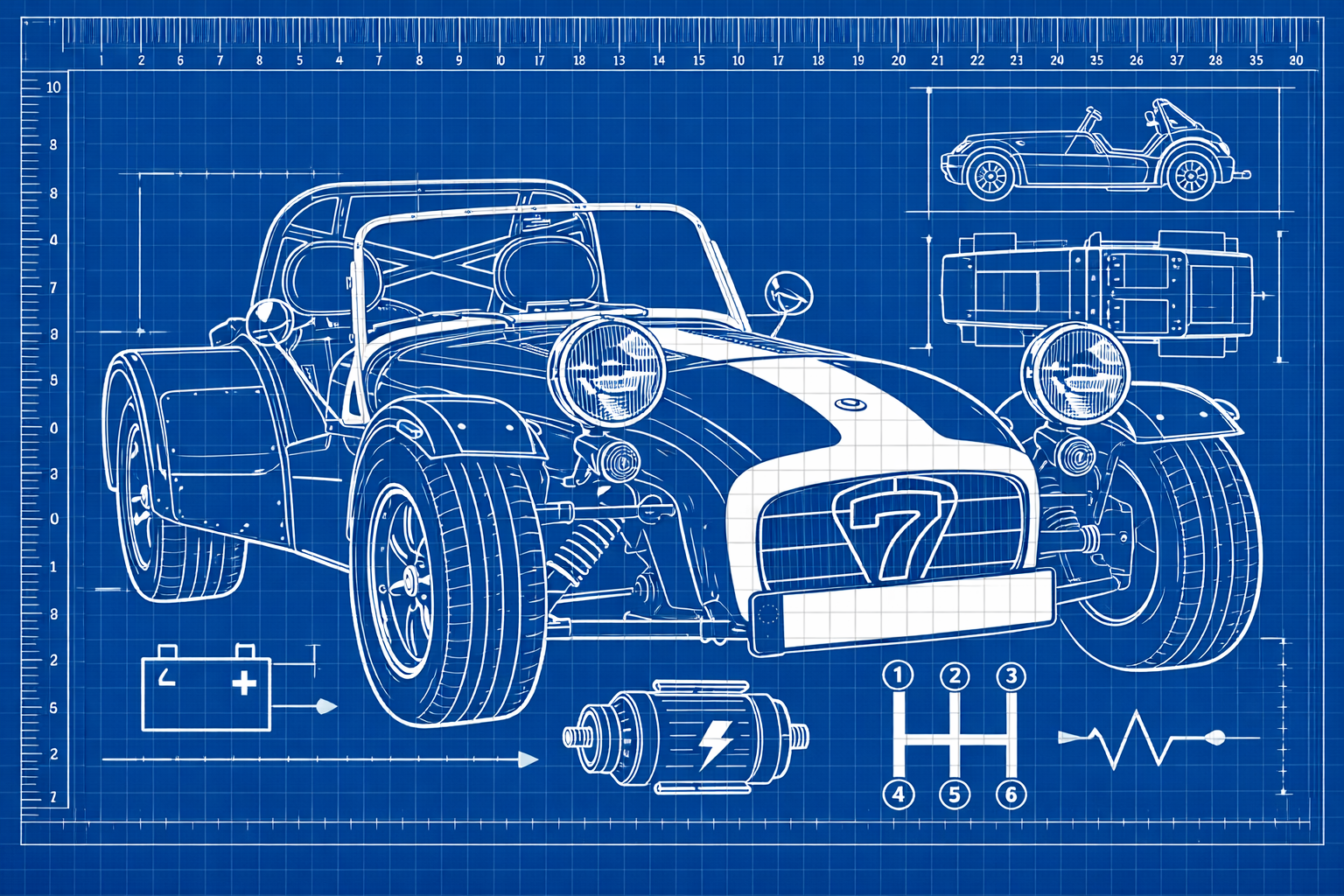
This post is about a project I’ve been thinking about for a long time—one I finally started over the holidays and plan to finish by summer 2026.
I’m converting my Caterham from combustion to electric while keeping the overall concept—including the manual transmission. This will be a series of blog posts where I’ll share the journey over the coming months. The goal is to get it street legal and drive through the narrow roads in the Austrian Alps.
Starting point
This is my Super Seven—bought a couple of years ago and a dream come true as a former Formula Student participant. Now I want to do what I enjoyed so much back then when I studied electrical engineering: building cars. This time, I’m converting from combustion to manual electric—something I’d buy if it were available, but since it’s not, I’m building it myself.


The stats so far:
- Weight: approx. 550kg
- Engine: Rover K-Series 1.8 Inline-4
- Gearbox: 5 speed manual
Why manual
I’m keeping the manual gearbox because I want to experiment with what a raw and engaging driving experience for an EV could look like. Nothing has convinced me yet—maybe it’s not possible, or maybe people have been overly focused on range and entertainment rather than the experience and sensation itself. This platform will be my personal exploration to see if there’s something unique to be created beyond the usual 0–60 stats.
Concept
The following simplified block diagram shows the overall concept:

Few comments:
- The battery will be air-cooled with a fan to boost airflow when needed. Since this is an open vehicle, natural circulation around the passenger seat and through openings in the footwell will provide sufficient cooling
- Since this is my first car rebuild, I’m keeping the power modest. I’ll use a Hyper 9 electric motor with 88kW—around 120hp. The manufacturer offers these motors as complete systems with an easy-to-manage inverter that runs at relatively low voltages.


- The front radiator and fan will remain in the car, along with the pump, to cool the inverter and motor. Coolant will flow through the inverter first, then the motor—since the motor tolerates higher temperatures better than the inverter. All other components will be passively cooled in the former engine bay.
- We’ll use off-the-shelf battery modules from Volkswagen—five modules with a nominal voltage of 29.6V each. This gives the high-voltage battery a total nominal voltage of 148V and a capacity of 34.25kWh. Each module weighs 32kg, so the complete battery pack will weigh approximately 160kg—replacing the passenger seat.

- As the voltage is too low (148VDC), we can’t support public DC charging – so the goal is to only support AC charging for now
- The VCU will be the control unit that defines the car’s characteristics—how the accelerator pedal translates to acceleration. I want to develop step by step what a manual EV should feel like. This might include a rev limiter, very low torque at low RPM, and even simulated stalling. Some vibration while idling with modulated low torque, similar to modern sim racing wheels. This is the unit that will transform a collection of components into a unique driving experience.
Next steps
- I need to dig into the battery module interface details (cell voltages, temperatures, etc.) and select a final BMS.
- Finalize the charging components and decide whether to go with a custom-designed VCU or something off the shelf.
- I found a CAD model online to use as a starting point for the overall model — first for integrating the electric motor and building the battery pack.
- Reach out and meet with authorities to understand all design requirements for street legality